


Strong nonprofit finances depend on more than recording donations, paying bills, and preparing annual returns. Leaders need financial records that explain where money comes from, how restricted funds are used, whether programs stay within budget, and what risks deserve board attention. For organizations operating in Los Angeles, this becomes especially important when grants, donor funds, payroll, compliance filings, and program expenses move through the same financial system.
Current 2026 finance discussions also point toward faster reporting and better financial visibility. A September 2026 Forbes Finance Council review notes that automation can improve accuracy, visibility, and decision-making when organizations first improve the underlying process.
What Financial Challenges Do Nonprofits Face?
Nonprofit leaders often have to make financial decisions while balancing mission delivery, donor expectations, staffing costs, grants, and regulatory obligations. A simple income statement may not answer the questions a board or executive director actually needs answered.
Useful financial support can help organizations monitor:
- Restricted and unrestricted funding separately
- Program costs against approved budgets
- Accounts payable and receivable
- Payroll and operating expenses
- Cash reserves and upcoming obligations
- Grant-related spending and documentation
The IRS requires tax-exempt organizations to maintain records supporting reported income, expenses, receipts, and other financial information. Complete records can also make an IRS examination easier to manage.
That makes organized accounting more than an administrative task. It becomes part of responsible governance and informed decision-making.
How Can Better Accounting Improve Financial Control?
Good accounting gives leaders a clearer view of what has happened financially and what may happen next. For a nonprofit, that distinction matters because a healthy bank balance does not automatically mean that all available funds can be spent.
A practical accounting structure should help leadership:
- Compare actual spending with approved budgets
- Identify unusual transactions
- Review cash flow regularly
- Track liabilities before they become urgent
- Separate program, administrative, and fundraising costs
- Prepare reliable reports for boards and stakeholders
Forbes reported in August 2026 that finance reporting is moving toward more timely information that helps leaders anticipate challenges rather than simply review past results.
This is where nonprofit accountant services in Los Angeles can provide practical value. The goal should not be more spreadsheets for the sake of more spreadsheets. It should be clearer information that helps leadership ask better questions and act with greater confidence.
Why Do Nonprofits Need Stronger Grant and Fund Tracking?
Grant accounting can become complicated when different funding sources carry different restrictions, reporting schedules, or spending conditions. A nonprofit may have enough total cash while still lacking enough unrestricted cash to cover everyday operations.
Leaders should regularly review:
- Grant budgets versus actual expenses
- Restricted versus unrestricted balances
- Matching-fund requirements
- Reporting deadlines
- Eligible and ineligible costs
- Documentation supporting grant expenditures
A useful example is a nonprofit receiving a restricted grant for a youth program. Paying an unrelated administrative bill from that funding pool could create a reporting problem even when the organization has sufficient cash overall. Clear fund tracking reduces that risk. It also gives executive directors and boards a more accurate picture of which resources are available for immediate use and which must remain dedicated to specific purposes.
When Should A Nonprofit Consider an Independent Audit?
California has a specific audit threshold that nonprofit leaders should understand. The California Attorney General states that an annual audit is required for organizations reporting $2 million or more in total revenue.
An audit also becomes an important governance tool when an organization:
- Has reached the applicable revenue threshold
- Manages significant grant funding
- Faces increased donor scrutiny
- Has a growing board or audit committee
- Needs stronger financial controls
- Is preparing for major organizational growth
The California Attorney General’s guidance also explains that covered organizations must have audited annual financial statements prepared by an independent CPA.
For organizations evaluating nonprofit audit services in Los Angeles, preparation should begin well before the audit fieldwork. Clean reconciliations, organized supporting documents, consistent account coding, and documented controls can make the process far less stressful.
How Can Technology Make Nonprofit Accounting More Useful?
Technology can reduce repetitive work, but software alone does not fix weak financial processes. Forbes Finance Council’s September 2026 guidance emphasizes improving processes before automating them and highlights cash flow, month-end close, reconciliation, and compliance as areas where automation can help.
Nonprofits can evaluate whether their systems support:
- Automated bank and account reconciliation
- Digital approval workflows
- Real-time cash visibility
- Budget-to-actual reporting
- Secure document storage
- Automated recurring transactions
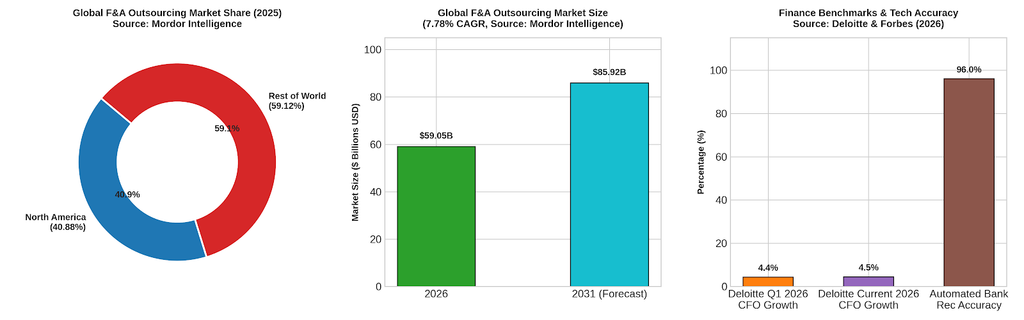
Mordor Intelligence estimates the global finance and accounting outsourcing market at $59.05 billion in 2026, with North America representing the largest regional share based on its 2025 market analysis.
The practical lesson is simple: organizations do not need technology for technology’s sake. They need systems that reduce manual effort while preserving review, accountability, and human judgment.
What Should Leaders Look For In Financial Support?
Choosing financial support should start with the organization’s actual needs. A small nonprofit with straightforward operations may need reliable bookkeeping and reporting, while a growing organization may need stronger controls, grant accounting, audit preparation, and financial planning.
Before engaging a provider, leadership can ask:
- Are nonprofit accounting requirements understood?
- Can financial reports be explained in plain language?
- How are restricted funds tracked?
- What controls exist around approvals and payments?
- Can reporting support board-level decisions?
- How are records prepared for tax filings or audits?
RTN CPA can support organizations by helping connect routine accounting work with clearer financial reporting and compliance processes. The important point is alignment. Financial support should fit the organization’s size, funding model, reporting requirements, and governance structure.
How can Better Financial Reporting Support Long-Term Planning?
Financial reports become more useful when they answer practical leadership questions. Can the organization sustain current staffing? Which programs are consuming more resources than planned? How long can existing reserves support operations if funding changes?
A useful planning process can include:
- Monthly financial reviews
- Rolling cash-flow forecasts
- Budget variance analysis
- Reserve monitoring
- Scenario planning for funding changes
- Regular board reporting
Forbes Nonprofit Council discussions in September 2026 have also highlighted reserves as a leadership issue, with financial decisions requiring a balance between protecting stability, funding growth, and supporting the mission.
That mindset changes the role of accounting. Instead of looking backward only, leaders can use financial information to prepare for the next decision.
| Statistic / Data Point | What It Shows | Source | Relevance to Nonprofits |
| $2 million or more in total revenue | California requires an annual independent audit for organizations reporting at least this level of total revenue. | California Attorney General, Registry of Charities and Fundraisers (California DOJ Attorney General) | Helps Los Angeles nonprofits understand when the state audit requirement generally applies. |
| $59.05 billion | Estimated global finance and accounting outsourcing market size in 2026. | Mordor Intelligence, 2026 market analysis (Mordor Intelligence) | Shows the growing use of external financial capabilities and technology-supported accounting. |
| $85.92 billion | Forecast global finance and accounting outsourcing market size by 2031. | Mordor Intelligence (Mordor Intelligence) | Provides longer-term context for the expansion of outsourced finance and accounting support. |
| 7.78% CAGR | Expected annual growth rate of the finance and accounting outsourcing market from 2026 to 2031. | Mordor Intelligence (Mordor Intelligence) | Indicates continued demand for outsourced accounting and financial capabilities. |
| 40.88% | North America’s share of the finance and accounting outsourcing market in 2025. | Mordor Intelligence (Mordor Intelligence) | Gives regional context for organizations considering external accounting support. |
| 4.5% | CFOs surveyed by Deloitte currently expect revenue growth of about 4.5% over the next 12 months. | Deloitte CFO Survey Data Dashboard, current 2026 data (Deloitte) | Demonstrates why organizations need timely financial information for planning and forecasting. |
| 4.4% | Comparable revenue-growth expectation in Deloitte’s Q1 2026 CFO forecast. | Deloitte CFO Survey Data Dashboard (Deloitte) | Provides a useful comparison with the current 4.5% outlook. |
| 8 million+ fraudulent payments prevented | A Forbes Finance Council contributor reported that AI tools at their organization prevented more than 8 million fraudulent payments in the previous year. | Forbes Finance Council, September 1, 2026 (Forbes) | Illustrates one possible use of automation in payment controls. This is a contributor-reported example, not an industry-wide statistic. |
| 80% more automated processing | The same Forbes contributor reported 80% more fully automated processing. | Forbes Finance Council, September 1, 2026 (Forbes) | Shows how automation can reduce manual finance workload when appropriate controls exist. |
| 96% accuracy | Xero’s CEO stated that its automated bank reconciliation was 96% accurate in a September 2026 Forbes CFO article. | Forbes CFO, September 8, 2026 (Forbes) | Provides a technology example while reinforcing the need for human review in financial processes. |
| 3-year minimum recordkeeping period | IRS guidance generally requires records supporting income, deductions, and credits to be retained for at least three years, subject to exceptions. | IRS, Form 990 instructions (IRS) | Reinforces the importance of organized nonprofit accounting records. |
Conclusion
Reliable nonprofit accounting supports much more than compliance. It helps presidents, executive directors, boards, and organizational leaders understand available resources, monitor risks, protect restricted funds, prepare for audits, and make informed choices about programs and growth.
For organizations evaluating nonprofit accountant services in Los Angeles, the strongest approach is practical and transparent: maintain accurate records, build useful reporting systems, review controls regularly, and connect financial information to mission decisions.
RTN CPA can help organizations build that connection through structured accounting and financial support. The ultimate objective is straightforward: give leadership dependable financial information that supports accountability today and sound planning for tomorrow.