

Grant funding fuels programs, community initiatives, educational projects, and public services across nonprofit organizations. Managing those funds effectively requires more than bookkeeping. Organizations must track expenditures accurately, demonstrate compliance, and provide transparent financial reporting to grantors and stakeholders. Strong financial controls help nonprofits maintain credibility while supporting long-term mission success.
Many nonprofit leaders face a common challenge. How can organizations balance program delivery with increasingly complex reporting requirements? Financial transparency, structured accounting processes, and proactive oversight create a practical solution that strengthens both operational performance and donor confidence.
Why Grant Management Demands Strong Financial Oversight
Grant providers expect organizations to demonstrate exactly how awarded funds are utilized. Financial records must support every reported expense and align with approved grant budgets.
Effective oversight helps organizations:
- Monitor spending against grant allocations
- Prevent unallowable expenditures
- Maintain documentation for audits
- Meet reporting deadlines
- Improve funding renewal opportunities
Many nonprofit executives discover that financial oversight becomes significantly easier when accounting systems are structured around grant-specific tracking rather than general fund accounting alone.
Accurate reporting also reduces administrative stress. Nobody enjoys searching through months of transactions the night before a reporting deadline.
Financial Transparency Has Become a Funding Requirement
Transparency is no longer viewed as an added advantage. Grantors increasingly expect real-time visibility into financial performance and program outcomes.
A recent Forbes Nonprofit Council article highlighted that organizations must account for the full cost of delivering impact rather than focusing solely on minimizing overhead expenses. Sustainable funding decisions increasingly depend on transparent financial reporting and clear documentation of resource utilization.
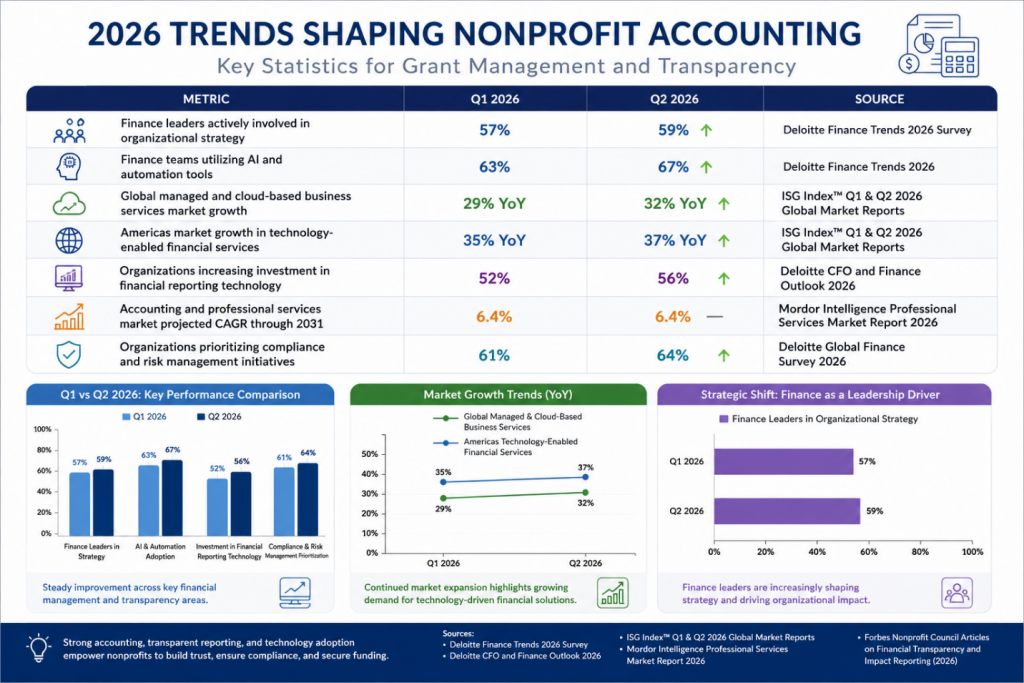
Finance leaders across industries are also prioritizing data-driven decision-making. Deloitte’s Finance Trends 2026 research found that 57% of finance leaders play a lead role in organizational strategy, reflecting the growing importance of financial visibility and accountability.
Organizations that establish transparent reporting frameworks often experience:
- Stronger donor confidence
- Improved board oversight
- Better grant renewal outcomes
- Faster audit preparation
- Enhanced operational decision-making
These advantages extend beyond compliance and contribute directly to organizational sustainability.
Key Components of Effective Grant Accounting
Grant accounting requires a structured approach that connects financial activities to program objectives and funding requirements.
Budget Tracking and Fund Segregation
Each grant typically carries unique restrictions, timelines, and reporting obligations. Segregating funds allows organizations to track expenditures accurately while preventing overlap between funding sources. Important practices include:
- Maintaining grant-specific accounts
- Monitoring budget variances regularly
- Reconciling expenditures monthly
- Reviewing allocation methodologies
Consistent tracking creates a clear financial trail that supports both internal reviews and external audits.
Financial teams should review grant performance throughout the funding cycle rather than waiting until reporting deadlines approach.
Compliance Monitoring and Documentation
Grant compliance extends beyond spending limits. Organizations must document procurement processes, payroll allocations, vendor payments, and program expenses. Essential documentation often includes:
- Grant agreements
- Budget approvals
- Expense records
- Payroll support schedules
- Vendor contracts
- Program activity reports
Proper documentation reduces audit risk and strengthens accountability across departments.
When questions arise from grantors, organized records provide answers quickly and confidently.
Financial Reporting for Stakeholders
Boards, donors, government agencies, and grant providers require clear financial information presented in an understandable format. Strong reporting frameworks typically include:
- Budget-to-actual comparisons
- Grant expenditure summaries
- Program cost analyses
- Cash flow monitoring
- Compliance status updates
Clear reporting helps leadership teams make informed decisions while reinforcing organizational credibility.
How a Nonprofit Accounting Firm in Sacramento Supports Accountability
Many nonprofit organizations operate with lean administrative teams. Leadership often focuses on fundraising, community engagement, and program delivery while managing complex financial responsibilities.
A nonprofit accounting firm in Sacramento can assist organizations by developing financial systems that support transparency and grant compliance. Professional accounting support may include:
- Grant accounting structure design
- Financial statement preparation
- Internal control assessments
- Audit readiness support
- Compliance monitoring
- Budget development assistance
RTN CPA works with nonprofit organizations and public sector entities that require accurate reporting, regulatory compliance, and reliable financial oversight. Structured accounting processes help organizations focus resources on mission-driven activities while maintaining accountability. Financial guidance also enables leadership teams to identify risks early and respond proactively before issues escalate.
Q1 and Q2 2026 Financial Trends Shaping Nonprofit Accounting
Several financial management trends emerged during the first half of 2026 that influence nonprofit accounting practices.
Q1 2026 Highlights
| Financial Trend | Q1 2026 Data | Relevance to Nonprofits |
| Finance leaders driving strategy | 57% of finance leaders actively shape enterprise strategy | Greater emphasis on financial transparency and governance |
| AI adoption in finance | 63% of finance teams actively use AI solutions | Improved reporting accuracy and efficiency |
| Global services market growth | 29% year-over-year increase in Q1 activity | Increased investment in financial technology and reporting tools |
| Americas services market growth | 35% year-over-year growth in Q1 | Strong demand for data-driven financial management |
Q2 2026 Observations
The second quarter continued emphasizing accountability, technology adoption, and outcome-based reporting. Grant providers increasingly sought measurable financial transparency alongside program performance metrics.
Organizations investing in stronger accounting systems positioned themselves to respond more effectively to evolving reporting expectations and audit requirements. Market research also projects continued growth in accounting and professional financial services through 2031, reflecting sustained demand for financial expertise.
Building a Sustainable Framework for Future Grants
Successful grant management begins long before funds are awarded. Organizations benefit from establishing financial policies, reporting standards, and internal controls that support future funding opportunities.
Leadership teams should consider:
- Conducting periodic financial reviews
- Strengthening internal controls
- Updating accounting technology
- Training staff on compliance requirements
- Standardizing grant reporting procedures
A proactive approach reduces risk while creating a stronger foundation for organizational growth. Grantors appreciate transparency, and stakeholders value accountability. Strong accounting practices deliver both.
Q1 and Q2 2026 Nonprofit Accounting & Financial Management Statistics
Conclusion
Sacramento Nonprofit Accounting Services play a critical role in helping organizations manage grant funding responsibly while maintaining transparency and compliance. Accurate financial tracking, structured reporting, and effective internal controls allow nonprofits to demonstrate accountability to donors, boards, and funding agencies.
As reporting requirements continue evolving throughout 2026, organizations that prioritize financial transparency and grant management will be better positioned to secure future funding and strengthen stakeholder trust. RTN CPA supports nonprofits with accounting solutions designed to improve visibility, compliance, and long-term financial stewardship.
Common General Questions
Q. How do Sacramento Nonprofit Accounting Services improve financial transparency?
These services establish structured reporting systems, monitor fund usage, document expenses accurately, and provide stakeholders with clear financial information. Transparency helps organizations demonstrate accountability and build trust with funding agencies.
Q. What does a nonprofit accounting firm in Sacramento do during grant audits?
A nonprofit accounting firm in Sacramento helps organize financial records, verify supporting documentation, prepare audit schedules, review compliance requirements, and address auditor inquiries efficiently. Preparation reduces audit disruptions and strengthens financial credibility.
Q. Can a nonprofit accounting firm in Sacramento assist with restricted fund tracking?
Yes. Restricted fund tracking is a core component of nonprofit accounting. Firms help organizations segregate grant funds, monitor expenditures, and ensure spending aligns with donor or grantor restrictions.
Q. How often should nonprofits review grant-related financial reports?
Organizations should review grant reports monthly or quarterly, depending on funding requirements. Frequent reviews help leadership identify variances, maintain compliance, and address potential issues before reporting deadlines.
Q. What financial controls support successful Sacramento Nonprofit Accounting Services?
Key controls include fund segregation, approval workflows, reconciliation procedures, documentation standards, budget monitoring, and periodic compliance reviews. These controls improve accountability and reduce financial risk.
Q. When should an organization engage a nonprofit accounting firm in Sacramento?
Organizations should seek accounting support when managing multiple grants, preparing for audits, implementing new reporting requirements, or strengthening internal financial controls. Early involvement often improves efficiency and long-term compliance outcomes.