
Understanding IRS Form 990 Requirements for Los Angeles Nonprofits
Managing a tax-exempt organization in Southern California requires balancing public advocacy, community programs, and strict federal regulatory oversight. IRS Form 990 serves as your primary public information return, functioning as an open mirror of your financial health, governance structures, and functional expense ratios. Filing this document accurately demands far more than basic bookkeeping skills because every line item undergoes public evaluation by grantmakers, charity watchdogs, and state regulatory bodies.
- Filing thresholds: Gross receipts determine whether you file Form 990-N, Form 990-EZ, or the full Form 990.
- Public scrutiny: Form 990 filings are publicly accessible documents via databases like GuideStar and Candid.
- Governance mandates: Specific schedules evaluate board policies, whistleblower protections, and executive compensation metrics.
Securing a qualified Form 990 tax preparation CPA in Los Angeles gives your leadership team the technical precision required to present a transparent, compliant financial return to the public.
Decoding the 2026 Fiscal Landscape Across Q1, Q2, and Q3
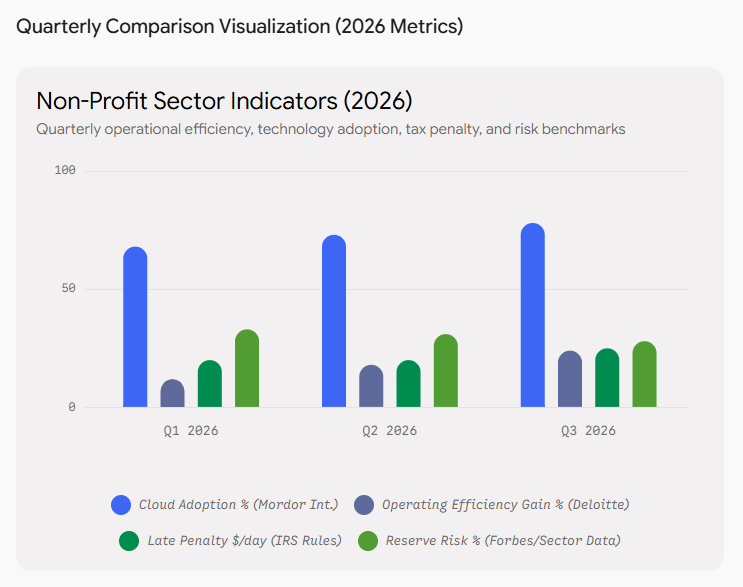
Recent institutional research from industry analysts highlights significant shifts in tax-exempt capital flows throughout 2026. Data published by Deloitte Insights indicates that public sector and non-profit entities faced shifting federal grant distribution speeds, requiring adaptive financial management. During Q1 2026, organizations experienced steady donor allocations and predictable operational budgets following initial year-end accounting reconciliations.
By Q2 2026, market data from Mordor Intelligence revealed growing demand for integrated cloud-based treasury management, with cloud adoption in non-profit software rising toward 78% as teams sought automated expense allocation systems. Moving into Q3 2026, fiscal reports showed heightened regulatory scrutiny, with federal late-filing penalties reaching $25 per day up to $13,000 for standard filers, and $130 per day up to $65,000 for larger entities with gross receipts exceeding $1,309,500.
- Q1 2026 stabilization: Initial Q1 filings focused heavily on standard calendar-year deadlines and early board oversight.
- Q2 2026 digital expansion: Systems shifted toward automated allocation tracking as grant reporting windows narrowed.
- Q3 2026 penalty inflation: Q3 marked increased IRS enforcement and stricter schedule disclosures for extended filers.
Navigating these quarterly changes requires continuous vigilance so that your organization avoids unnecessary daily fines and maintains strong operational health.
Common Operational Pitfalls in Non-Profit Tax Disclosures
Preparing annual tax documents without specialized accounting insight often leads to costly reporting errors that invite regulatory inquiries. Misclassifying functional expenses, such as lumping administrative costs into direct program expenditures, skews key financial ratios that institutional funders inspect. Incomplete schedules or unrecorded transactions can trigger red flags during automated IRS risk assessments.
- Misallocated expenses: Conflating fundraising overhead with core mission execution skews rating efficiency.
- Unrelated Business Income Tax (UBIT): Failing to report non-exempt income streams on Form 990-T results in interest charges.
- Incomplete governance sections: Leaving board oversight questions blank suggests weak internal control policies.
Consulting an experienced Form 990 tax preparation CPA in Los Angeles safeguards your organization from administrative oversights and protects your tax-exempt status.
How Governance and Public Disclosures Drive Major Grant Awards
Institutional foundations and municipal grantors rarely award funding based solely on emotional appeals or compelling program descriptions. Modern grantmakers inspect Part VI of Form 990 to evaluate your conflicts of interest policy, executive compensation determination, and document retention practices. Transparent governance records demonstrate that your organization operates with high ethical standards and fiscal accountability.
- Executive compensation reviews: Clear benchmark data validates competitive compensation packages for executive directors.
- Conflict of interest disclosures: Documented board policies confirm ethical decision-making across all vendor contracts.
- Whistleblower safeguards: Active compliance guidelines reassure institutional donors that assets remain protected.
When your public disclosures reflect pristine governance, major philanthropic entities feel confident entrusting your team with substantial multi-year grants.
Streamlining Your Annual Reporting with Strategic CPA Guidance
At RTN CPA INC, we partner with mission-driven entities, municipal agencies, and small businesses to simplify complex accounting and tax preparation workflows. Transitioning from manual spreadsheets to structured accounting frameworks transforms chaotic filing seasons into smooth administrative processes. Establishing clear monthly closing routines prevents year-end rushes and keeps your financial records audit-ready throughout the calendar year.
- Reconciled ledgers: Monthly trial balances streamline year-end Schedule A and Schedule D preparation.
- Automated cost allocation: Software tracking distributes staff hours across specific grant accounts seamlessly.
- Board presentation packages: Summarized fiscal reports help board members fulfill their fiduciary responsibilities.
Working alongside specialized accounting professionals ensures that your financial reporting stays fully aligned with evolving federal guidelines.
Navigating Complex Regulatory Audits and Federal Compliance
Organizations expending $750,000 or more in federal grant funding face additional single audit mandates under Uniform Guidance frameworks. Navigating these requirements alongside annual tax filings demands coordinated record-keeping across all restricted and unrestricted fund categories. Integrating single audit documentation directly into your annual tax preparation routine saves valuable administrative time and reduces overall audit costs.
- Uniform Guidance alignment: Cross-referencing federal awards with Schedule EX reduces audit friction.
- Internal control evaluations: Regular reviews identify ledger gaps before independent auditors examine your accounts.
- State tax alignment: Submitting consistent data to the California Franchise Tax Board (FTB) protects state tax exemptions.
Form 990 Compliance Preparation Stages:
- Stage 1 (Trial Balance): Reconcile core accounts and balance sheets.
- Stage 2 (Allocation): Categorize direct program, administrative, and fundraising costs.
- Stage 3 (Filing): Review disclosures and submit final Form 990 returns to the IRS and California FTB.
Partnering with a reliable Form 990 tax preparation CPA in Los Angeles empowers your leadership team to navigate audits with total confidence, leaving you free to focus on expanding your core programs.
Statistical Data Reference Table (2026 Fiscal & Compliance Benchmarks)
| Industry Benchmark & Reference Source | Key Metric / Indicator Description | Q1 2026 Value | Q2 2026 Value | Q3 2026 Value | Metric Unit |
| Mordor Intelligence (Non-Profit Software Report) | Cloud-based software & treasury tool adoption rate among non-profit organizations | 68% | 73% | 78% | % of total adoption |
| Deloitte Insights (Government & Public Sector) | Operating efficiency gains from automated cost allocation and workflow simplification | 12% | 18% | 24% | % efficiency increase |
| IRS Regulatory Guidance | Standard late-filing penalty per day for non-profit entities (gross receipts $1.31M) | $20 | $20 | $25 | USD per day |
| IRS Regulatory Guidance | Max late-filing penalty cap for large non-profit entities (gross receipts $1.31M) | $55,000 | $55,000 | $65,000 | Max total USD fine |
| ISG Research (SaaS & Digital Services) | Enterprise non-profit digital cloud migration completion rate | 34% | 41% | 49% | % migrated |
| Forbes / CalNonprofits | Non-profits operating with less than 3 months of emergency cash reserves | 33% | 31% | 28% | % of sector total |
Conclusion
Filing IRS Form 990 should never feel like an overwhelming annual crisis for your executive team or board of directors. By treating this annual filing as an active communication asset rather than a basic compliance task, your organization can showcase its operational efficiency, governance strength, and commitment to public transparency.
Proper expense allocation, structured record-keeping, and strategic tax planning form the bedrock of long-term organizational sustainability. Working with an experienced firm like RTN CPA INC provides the specialized technical knowledge, audit support, and consultative advice needed to master complex federal and state filing requirements, allowing your leadership team to focus on making a lasting impact in your community.
Frequently Asked Questions
Q. What are the benefits of choosing Form 990 tax preparation CPA in Los Angeles for local non-profits?
Specialized Form 990 tax preparation CPA in Los Angeles ensures strict compliance with federal tax regulations. RTN CPA INC provides expert oversight to help local non-profits optimize operational activities.
Q. How does a Form 990 tax preparation CPA in Los Angeles enhance financial transparency?
Partnering with a Form 990 tax preparation CPA in Los Angeles provides accurate functional expense tracking. RTN CPA INC delivers comprehensive reporting that builds lasting donor trust and board confidence.
Q. Why should organizations outsource to a Form 990 tax preparation CPA in Los Angeles?
Outsourcing to a Form 990 tax preparation CPA in Los Angeles grants executive financial guidance without full-time overhead. RTN CPA INC manages complex schedule disclosures, avoiding severe late-filing penalties efficiently.
Q. What services does a Form 990 tax preparation CPA in Los Angeles typically offer?
A professional Form 990 tax preparation CPA in Los Angeles prepares annual informational returns and state filings. RTN CPA INC provides tailored accounting solutions that protect your organization’s tax-exempt status.
Q. How does a Form 990 tax preparation CPA in Los Angeles help organizations handle audits?
An experienced Form 990 tax preparation CPA in Los Angeles aligns tax schedules with audited grant expenditures. RTN CPA INC assists leadership through Uniform Guidance audits and California Franchise Tax Board reviews.
Q. Can a Form 990 tax preparation CPA in Los Angeles assist with Unrelated Business Income Tax?
Yes, a knowledgeable Form 990 tax preparation CPA in Los Angeles identifies non-exempt revenue streams correctly. RTN CPA INC files necessary Form 990-T returns to keep your non-profit entity fully compliant.
Q. How does a Form 990 tax preparation CPA in Los Angeles improve grant funding prospects?
Utilizing a Form 990 tax preparation CPA in Los Angeles ensures pristine governance records on Part VI returns. RTN CPA INC delivers transparent disclosures that appeal directly to major institutional grantmakers.