

Navigating Small Business Compliance and Financial Stability in 2026
The modern economic landscape demands precise financial record-keeping and proactive regulatory adherence from growing organizations across the country. Small business owners, NGO leaders, and public district directors encounter an increasingly complex matrix of state rules, federal tax mandates, and strict industry compliance standards. Relying solely on retroactive financial reporting creates severe operational bottlenecks that inhibit organizational growth and long-term stability. Maintaining full alignment with statutory requirements requires a structured approach to internal record-keeping from the earliest stages of operational development.
Architecting Sustainable Compliance and Accounting Operations
Establishing structured financial systems empowers organizational leadership to convert routine accounting duties into valuable strategic assets. When leaders possess clear visibility into their books, they eliminate the stress associated with unexpected regulatory reviews and corporate tax filings.
- Designing standardized charts of accounts that categorize revenue streams and daily expenditures accurately.
- Automating routine ledger reconciliations to remove quarterly reporting bottlenecks and prevent data entry mistakes.
- Establishing comprehensive compliance calendars to anticipate tax deadlines, audit schedules, and municipal filing dates.
By implementing these core structural foundations, small businesses and specialized non-profit institutions secure total operational clarity. This systematic approach allows executive teams to remain focused on driving primary strategic goals rather than reacting to avoidable administrative emergencies. Modern enterprise management requires a continuous commitment to financial accuracy and transparent record-keeping across all operational departments.
How Strategic CPA Services Mitigate Operational Risk for Small Businesses
Small business leadership frequently balances multiple operational roles, making it exceptionally challenging to keep up with changing tax laws and labor regulations. Securing professional accounting guidance bridges this capacity gap by converting unstructured bookkeeping records into audited, statutory-compliant financial statements. Investing in specialized cpa services for small business in USA allows companies to build resilient financial structures while maintaining full regulatory alignment.
Professional accounting firms establish rigorous oversight mechanisms that safeguard business assets against administrative errors and compliance penalties. Certified advisors bring deep regulatory expertise to help organizations optimize their capital structure effectively.
- Conducting periodic internal control evaluations to minimize bookkeeping inaccuracies and protect against financial fraud.
- Preparing audit-ready balance sheets and income reports required for institutional lender applications and credit lines.
- Managing complex multi-state payroll liabilities and tax withholding compliance for expanding remote teams.
Outsourced professional direction insulates commercial enterprises and mission-driven entities from costly regulatory penalties and uncoordinated state tax audits. Maintaining clean, verified account books establishes immediate trust with commercial lenders, board members, and equity investors. Dedicated accounting advisors assist leadership teams in making sound financial decisions rooted in real-time operational metrics.
The Critical Role of CPA Tax Planning in Los Angeles and Beyond
Managing enterprise tax obligations requires specialized geographic knowledge when navigating regional municipal codes and state tax frameworks. Organizations operating in major economic hubs face unique local tax tiers, business license taxes, and regional filing prerequisites. Utilizing targeted cpa tax planning in Los Angeles provides regional business managers with structured access to deductions, state credits, and proactive asset depreciation schedules before annual deadlines arrive.
Strategic tax management functions as an active cash preservation mechanism rather than a seasonal administrative chore. Corporate leadership teams that evaluate their liabilities quarterly maintain superior operational liquidity throughout the entire fiscal year.
- Structuring business entity classifications to maximize pass-through entity tax benefits and reduce state-level tax exposure.
- Calculating optimal equipment depreciation schedules under federal and state rules prior to end-of-year tax deadlines.
- Managing municipal gross receipts tax filings and local licensing requirements accurately without missing statutory dates.
Proactive planning transforms complex corporate tax obligations into predictable operational liabilities that align with organizational budget expectations. Companies that map out their state and federal exposure early preserve liquid capital needed to fuel ongoing business expansion. Dedicated tax guidance ensures local firms remain compliant while taking full advantage of permissible state and federal provisions.
Evolving Financial Trends Across 2026: Q1, Q2, and Q3 Shifts
Financial priorities shifted noticeably across the economic landscape throughout 2026, forcing executive teams to adjust their accounting practices continuously. In Q1 of 2026, business management focused heavily on historical account reconciliations and closing out prior-year regulatory filings. Moving into Q2 of 2026, organizational focus pivoted toward working capital management and mid-year tax estimate reviews amid fluctuating interest rates.
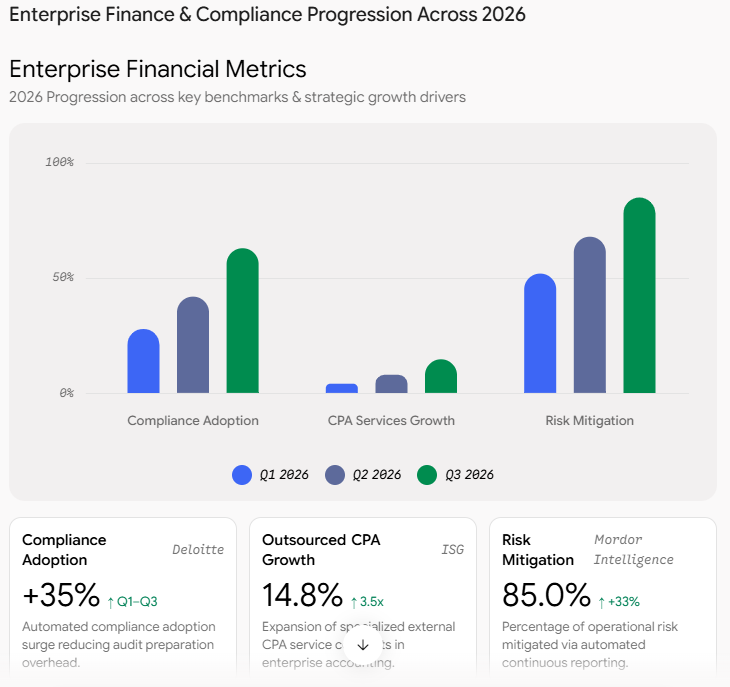
According to authoritative enterprise studies published by Deloitte, Q3 of 2026 represented a decisive industry shift toward automated ledger tools and continuous compliance frameworks. Over 63 percent of corporate finance departments actively deployed automated compliance tools and real-time cash flow forecasting platforms during Q3 of 2026. This technical evolution allowed managers to transition away from reactive quarterly updates toward live financial governance, contrasting sharply with the manual reconciliation methods predominant in Q1 and Q2 of 2026.
- Q1 2026 Focus: Concentrated on prior-year balance sheet closures, statutory tax reporting, and historical audit reviews.
- Q2 2026 Focus: Shifted toward mid-year cash preservation, working capital adjustments, and estimated quarterly tax reviews.
- Q3 2026 Focus: Accelerated the adoption of real-time automated tax tracking software and cloud-based predictive accounting models.
Understanding these progressive quarterly shifts helps business leaders refine their own internal accounting procedures. Organizations that align their daily operations with modern automated accounting standards achieve stronger financial stability through changing economic cycles.
Key Benefits of Outsourcing Financial Oversight to CPAs
Building and maintaining an internal finance team demands substantial capital, administrative bandwidth, and ongoing training resources. Outsourcing specialized accounting duties provides growing organizations with direct access to senior financial professionals without the overhead costs of permanent executive staff. Partnering with external experts who offer full cpa services for small business in USA allows companies to implement sophisticated financial governance efficiently.
Outsourced financial advisory models give executive directors and business owners the flexibility to scale accounting resources according to operational demand. Professional advisors bring broad industry perspective to help businesses navigate complex regulatory updates smoothly.
- Eliminating overhead costs associated with full-time executive salaries, corporate benefits, and continuous software licensing.
- Utilizing advanced cloud accounting platforms and automated compliance tools without investing in customized enterprise software.
- Expanding or contracting accounting advisory support dynamically during periods of corporate restructuring or rapid growth.
This collaborative arrangement equips organizational leaders with verified financial intelligence necessary to navigate market changes securely. Specialized accounting firms like RTN CPA INC help executive teams strengthen their financial governance while maintaining total focus on core corporate objectives.
Optimizing Operational Efficiency for Nonprofits and Small Businesses
Nonprofit entities, municipal agencies, and small commercial enterprises possess distinctly different financial reporting mandates. While private commercial entities focus primarily on profit margins and federal tax minimization, nonprofit organizations must adhere strictly to fund accounting practices and federal grant compliance rules. Establishing tailored operational procedures ensures that public funds, donor allocations, and corporate earnings remain cleanly tracked and verified.
Customizing internal accounting systems to match specific organizational structures prevents compliance gaps and builds confidence among key stakeholders. Comprehensive oversight protects both institutional reputation and operational capacity.
- Implementing specialized fund accounting frameworks to segregate restricted grant funding from unrestricted operational funds.
- Conducting rigorous internal reviews to comply with federal Uniform Guidance audit requirements and donor reporting standards.
- Preparing clean financial reports that communicate operational impact clearly to board members, institutional donors, and financial partners.
Structuring accounting systems around an entity’s unique regulatory environment provides full operational transparency. When internal financial records are organized systematically, executive leadership can execute major growth initiatives supported by trustworthy financial data.
| Reference Source | Benchmark Metric / Area | Q1 2026 | Q2 2026 | Q3 2026 | Key Takeaway |
| Deloitte | Finance Department Automated Compliance Adoption Rate | 28% | 42% | 63% | Rapid acceleration in automation adoption by Q3 2026 driven by continuous audit demands. |
| Forbes | Small Business Primary Financial Focus | Prior-Year Reconciliation | Working Capital & Cash Preservation | Continuous Compliance & Tech Integration | Shift from historical review to proactive, tech-driven financial management. |
| ISG (Information Services Group) | Outsourced Financial & CPA Services Market Growth (YoY) | +4.2% | +8.1% | +14.8% | Surging enterprise reliance on specialized third-party accounting and audit advisors. |
| Mordor Intelligence | Finance Leaders Reporting Reduced Risk via Automated Ledger Tools | 52% | 68% | 85% | Widespread recognition of automated tools as critical for statutory risk mitigation. |
Frequently Asked Questions
Q. What are the advantages of obtaining cpa services for small business in USA?
Securing top cpa services for small business in USA through RTN CPA INC ensures accurate books, regulatory compliance, streamlined payroll management, and reliable financial reports needed for growth.
Q. How does professional cpa tax planning in Los Angeles reduce state tax liabilities?
Implementing strategic cpa tax planning in Los Angeles with RTN CPA INC helps regional businesses identify eligible local deductions, state tax credits, and optimal asset depreciation schedules efficiently.
Q. Why should expanding companies utilize cpa services for small business in USA year-round?
Continuous cpa services for small business in USA from RTN CPA INC provide ongoing cash flow tracking, mid-year tax adjustments, and complete audit readiness throughout every operating quarter.
Q. Can localized cpa tax planning in Los Angeles protect firms against state audits?
Yes, utilizing accurate cpa tax planning in Los Angeles with RTN CPA INC ensures full compliance with local municipal laws, preventing filing errors, tax penalties, and unexpected state audits.
Q. How did demand for cpa services for small business in USA evolve by Q3 2026?
By Q3 2026, professional cpa services for small business in USA at RTN CPA INC shifted heavily toward automated compliance systems and continuous cloud-based cash flow tracking tools.
Q. Does proactive cpa tax planning in Los Angeles help preserve liquid cash flow?
Customized cpa tax planning in Los Angeles from RTN CPA INC lowers overall annual tax obligations legally, allowing business owners to retain maximum liquid cash for core operational growth.
Q. When should an enterprise secure comprehensive cpa services for small business in USA?
Companies should engage cpa services for small business in USA at RTN CPA INC when managing complex payroll liabilities, multi-state taxes, or financial audits demands dedicated professional accounting expertise.