


Financial visibility has become a critical requirement for organizations that manage grants, public funds, operational budgets, and business growth initiatives. Leaders who rely on current financial data can make informed decisions, identify risks early, and maintain accountability across departments. Daily financial management creates a foundation for stronger governance, improved reporting accuracy, and sustainable growth.
Organizations throughout Southern California face increasing pressure to maintain transparent records while responding to evolving compliance requirements. This makes accounting and bookkeeping services in Los Angeles an important operational resource for nonprofit organizations, government entities, executive directors, and small-business owners seeking greater financial clarity.
Effective financial management extends beyond balancing accounts. It creates a system that supports strategic planning, budget control, and organizational confidence. When financial information remains accurate and accessible, leadership teams spend less time searching for answers and more time focusing on organizational goals.
Why Daily Financial Tracking Matters More Than Ever
Financial decisions occur every day. Vendor payments, grant expenditures, payroll processing, and project costs all influence organizational performance. Without consistent tracking, small discrepancies can grow into significant reporting challenges.
Several industry developments highlight the importance of strong financial oversight:
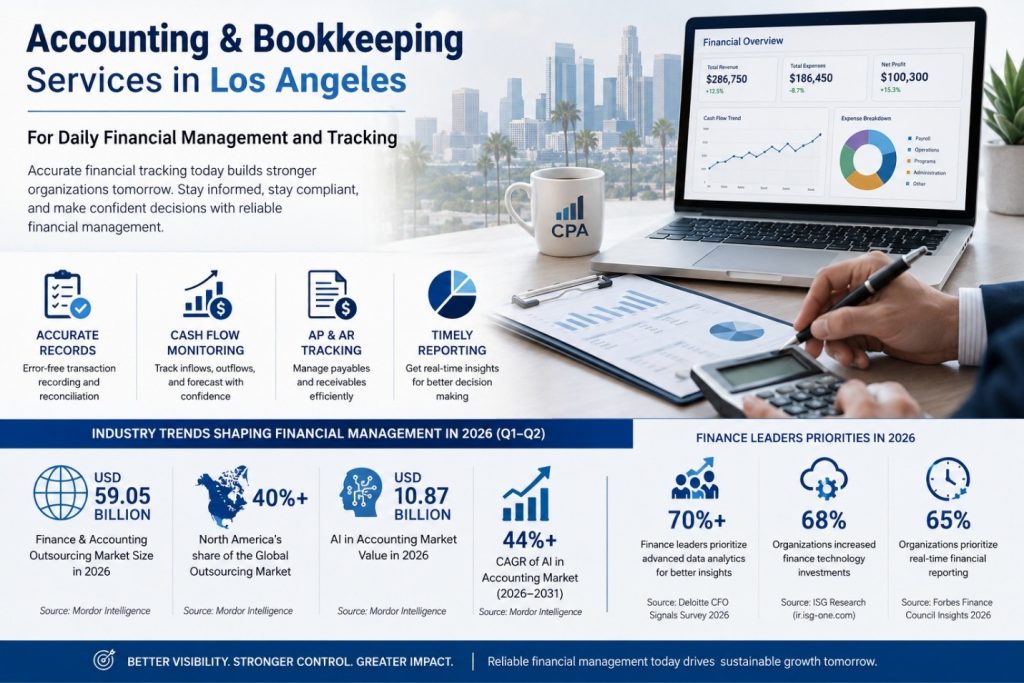
- The global finance and accounting outsourcing market is projected to reach approximately $59.05 billion in 2026, reflecting growing demand for professional financial management solutions.
- North America continues to lead adoption of outsourced finance solutions, accounting for more than 40% of market activity.
- The AI-driven accounting market is expected to reach $10.87 billion in 2026 as organizations increasingly automate routine financial processes.
These trends demonstrate how organizations are prioritizing financial accuracy, reporting efficiency, and real-time visibility.
Daily tracking also allows leadership teams to identify spending patterns before they become budget concerns. Timely insights help organizations remain proactive rather than reactive.
Key Components of Effective Financial Management
Accurate Transaction Recording
Every financial decision begins with reliable records. Missing or misclassified transactions can affect budgets, audits, grant reporting, and tax compliance.
Strong bookkeeping processes typically include:
- Daily transaction entry
- Expense categorization
- Bank reconciliation
- Documentation management
- Internal review procedures
Accurate records create consistency across all financial reports. Decision-makers gain confidence when numbers align across departments and reporting periods.
Cash Flow Monitoring
Revenue may appear healthy on paper, yet cash flow challenges can still disrupt operations. Organizations need visibility into both incoming and outgoing funds.
Effective monitoring includes:
- Tracking available cash balances
- Reviewing upcoming obligations
- Identifying seasonal fluctuations
- Forecasting short-term financial needs
Regular cash flow reviews help prevent unexpected shortages and support responsible financial planning.
Accounts Payable and Receivable Tracking
Unpaid invoices and delayed collections often create operational bottlenecks. Monitoring both payables and receivables supports healthier financial performance.
Key practices include:
- Invoice verification
- Payment scheduling
- Collection monitoring
- Aging report reviews
- Vendor management
Organizations that maintain consistent oversight often experience fewer payment disputes and stronger supplier relationships.
How Organizations Benefit from Professional Financial Oversight
Reliable financial management creates value across multiple levels of an organization. Leaders gain access to meaningful information that supports planning, compliance, and operational efficiency.
Benefits commonly include:
- Improved financial transparency
- Faster reporting cycles
- Stronger budget control
- Reduced administrative burden
- Better audit preparedness
- Enhanced stakeholder confidence
For many organizations, accounting and bookkeeping Services in Los Angeles provide structured processes that support both daily operations and long-term planning.
Financial information becomes more useful when it arrives at the right time. Timely reports help leadership teams evaluate performance and respond quickly to changing conditions.
Technology’s Role in Modern Accounting Operations
Financial technology continues to transform accounting workflows. Automation tools reduce manual tasks while improving consistency and reporting speed.
Recent industry data indicates that the AI accounting sector is projected to grow at a compound annual growth rate exceeding 44% between 2026 and 2031.
Modern financial systems frequently support:
- Automated transaction matching
- Digital invoice processing
- Real-time dashboards
- Cloud-based document storage
- Financial forecasting tools
RTN CPA works with organizations that require both technological efficiency and professional oversight. Technology can streamline processes, but experienced financial review remains essential for maintaining accuracy and compliance.
Successful organizations view automation as a support tool rather than a replacement for financial judgment. Human oversight continues to play a critical role in interpreting financial data and identifying exceptions.
Common Financial Tracking Challenges for Growing Organizations
Growth often introduces additional financial complexity. New funding sources, expanding operations, and increasing transaction volume can strain existing processes.
Common challenges include:
- Inconsistent recordkeeping
- Delayed reconciliations
- Limited reporting visibility
- Budget tracking difficulties
- Compliance documentation gaps
- Resource constraints
Addressing these issues early helps organizations avoid larger reporting and operational concerns later.
A simple question often reveals the effectiveness of a financial system: Can leadership obtain accurate financial information when needed? If the answer requires extensive searching, improvements may be necessary.
Building a Reliable Financial Management Framework
Organizations benefit from a structured financial management approach that balances accuracy, efficiency, and accountability.
A strong framework often includes:
- Clearly defined financial procedures
- Regular reconciliations
- Monthly financial reviews
- Budget monitoring practices
- Internal controls
- Document retention standards
Consistent execution matters more than complexity. A straightforward system followed consistently often delivers stronger results than an elaborate process used inconsistently.
Leaders who prioritize financial visibility position their organizations to respond confidently to operational, funding, and compliance demands.
| Statistic | Q1/Q2 2026 Data | Relevance to Daily Financial Management and Tracking | Source |
| Global Finance & Accounting Outsourcing Market Size | USD 59.05 Billion (2026) | Demonstrates growing reliance on professional accounting and bookkeeping support for operational efficiency and compliance. | Mordor Intelligence |
| North America’s Share of Finance & Accounting Outsourcing Market | Over 40% of the Global Market (2026) | Highlights strong adoption of outsourced accounting solutions among organizations in the U.S. and Canada. | Mordor Intelligence |
| AI in Accounting Market Value | USD 10.87 Billion (2026) | Reflects increased investment in automation, real-time reporting, and financial tracking technologies. | Mordor Intelligence |
| AI in Accounting Market Growth Rate | CAGR of 44%+ (2026-2031 Forecast) | Indicates rapid expansion of technology-driven financial management systems and bookkeeping automation. | Mordor Intelligence |
| CFO Priority on Financial Data Analytics | More than 70% of finance leaders cite advanced analytics as a strategic priority in 2026 | Shows the growing importance of timely financial insights for decision-making and forecasting. | Deloitte CFO Signals Survey 2026 |
| Organizations Increasing Digital Finance Investments | Approximately 68% of organizations increased finance technology spending in early 2026 | Supports the shift toward cloud accounting, automated reconciliations, and financial dashboards. | ISG Research |
| Businesses Prioritizing Real-Time Financial Reporting | Nearly 65% of organizations identified real-time reporting as a key finance objective for 2026 | Demonstrates demand for accurate daily financial tracking and operational visibility. | Forbes Finance Council Insights 2026 |
Conclusion
Daily financial management supports informed decision-making, accountability, and long-term organizational stability. Accurate bookkeeping, consistent tracking, and timely reporting help organizations maintain control over resources while improving transparency for stakeholders.
As financial operations continue to evolve through automation and data-driven reporting, organizations require systems that combine efficiency with professional oversight. RTN CPA supports organizations seeking dependable financial management processes that strengthen reporting accuracy, operational visibility, and strategic planning capabilities.
Common General Questions
Q. How do accounting and bookkeeping services in Los Angeles support nonprofit organizations?
These services assist with fund tracking, grant reporting, expense management, financial transparency, and preparation for audits while supporting compliance requirements.
Q. What reports are commonly provided through accounting and bookkeeping Services in Los Angeles?
Organizations often receive balance sheets, income statements, cash flow reports, budget comparisons, accounts receivable reports, and accounts payable summaries.
Q. Can accounting and bookkeeping Services in Los Angeles help improve cash flow management?
Yes. Regular monitoring of incoming and outgoing funds helps leadership identify trends, anticipate obligations, and make proactive financial decisions.
Q. How frequently should financial records be updated?
Daily updates provide the highest level of visibility and accuracy. Consistent tracking reduces reporting errors and simplifies month-end reconciliation processes.
Q. What role does technology play in modern bookkeeping?
Technology automates routine tasks such as transaction matching, invoice processing, document storage, and reporting while improving efficiency and data accessibility.
Q. How can organizations determine whether their current financial tracking process is effective?
An effective process delivers timely, accurate, and easily accessible financial information that supports budgeting, compliance, strategic planning, and operational oversight.